
An Akah woman who was threshing rice with a foot operated mortar and pestle.

The school yard as we left.

My guide Ketko explains the books to the teachers.

The children are filled with curiosity.

In one of the classrooms, the students made replicas of the baskets they would need to make as adults.

These two female teachers hosted us for tea and we tried to help them understand how they might be able to use the books we brought.

Late day sun.

Two Akah singers. The woman had a cell phone in her lap while she sang.

My dinner companions the first night.

This chinese farmer has leased this land from the Akah for 6 months to grow watermelon which he will export to China.

Hand tilled to plant sugar cane which takes 12 months to grow.

Breakfast


Satellite dishes have arrived.
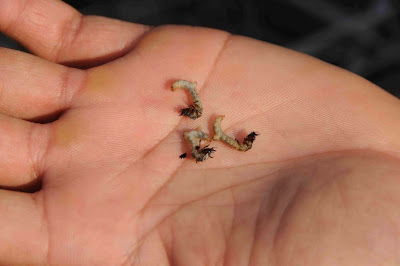
The guide showed me that if you put a piece of grass into a small hole in the dirt and waited for it to move, you could yank out a grub, which he said as a child he would use for fishing. After showing me this, he put each grub back into it's hole.

This house will be put up with the help of the villagers in 4 days. It will take the family 1-2 years to harvest and hand cut the boards.

A local snack shop.

Late in the day coming back from the fields.

I'd never seen a large piece of modern furniture like this in an Akah house. This one had a TV in it and everybody was watching Thai soap operas.

The Akah use slash and burn farming techniques. They have cut down the forest to plant sugarcane and rubber for China.

Pool hall.

Stone rice mill

This wild rooster was kept to hunt others in the woods. He would be taken into the woods to lure others, which would then be shot or caught.
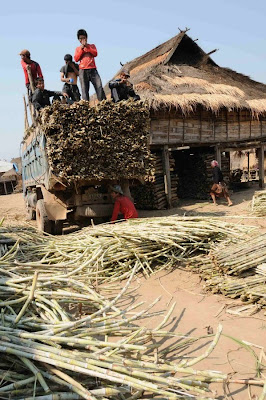
Loading sugarcane.

Feeding the pigs.

Bedroom eyes.

This village had just gotten electricity last month.

An Akah spirit gate with wooden guns on it.

Lunch

These two Akah women walked three hours to bring lunch to this waterfall and then back to the village with us.

My Akah guide Horcher giving me a taste of bark that they eat. It tasted like teaberry.
Joe's 2007 three-day trek among the Akah mountain tribe of northern Laos was one of the highlights of that year's trip for him---and of his entire life---and I wondered if this year's Akah visit might be anticlimactic or even a bit disappointing. It was neither. He returned to the Boat Landing Lodge in Luang Namtha at the end of the third day weary but thrilled.
The Akah are growers of rice, sticky rice, vegetables, sugar cane and rubber. They used to grow opium poppies but the government put a stop to that. They keep chickens, pigs and water buffalo. The buffalo help till the fields and drag wood from the forest for home construction. The Akah are animists who have a spirit gate at the path entering each village. Bad spirits cannot get through it.
Joe so likes the Akah (who are also found in northern Thailand and Burma) because they are so wonderfully close to nature. He says it's hard to tell sometimes where the Akah leave off and the natural world begins. He saw this in the way his Lao guide Ketko and his Akah guide Horcher produced tasty meals and snacks out of jungle plants. He had sweet, edible flowers. He ate the inner bark of a tree that tasted like teaberry. He had tiny chestnuts that were as palatable as they were odd. He ate sour plant stems and sweet, sweet honey.
The Akah, like most rural people in Southeast Asia, use bamboo, which grows everywhere, for nearly everything. The young shoots are good in soup or stir-fried. Joe bought a hand-forged knife in a bamboo sheath from a villager for five dollars. He saw a woman walking through a village singing and spinning cotton on a portable bamboo gizmo. Houses are made of bamboo and teak. Another plant pruduces a leaf that becomes a musical instrument that, when blown through, resonates like no sound Joe ever heard.
Another reason Joe likes being among the Akah is seeing a way of life that has changed little in hundreds of years. Although, now that change has started, it's moving fast. In the three years since his last visit, Joe has seen the arrival in some villages of electricity. It's provided inexpensively by the government. The first thing people want is---of course, of course---television. So you have bamboo houses with enormous satellite dishes, and inside people are watching Thai soap operas. Many Akah don't speak Lao, but they have learned Thai from the soap operas.
And even before electricity came---what first? Yes, cell phones! Lots of the Akah have them, although Joe says many can't afford more minutes for their SIM cards, so they just fool around with the phones. Part of the entertainment provided by Joe's Green Discovery trek (for which villagers receive a share of the fee) is a personal performance of traditional Akah music. The songfest for Joe was interrupted a number of times by ringing cell phones.
Dress is changing too. The Akah black outfits with colorful embroidery are being replaced by the same Chinese Wal-Mart style stuff most people on the planet now toss on. It's cheap and easy to come by.
The Chinese are also altering the Akah economy. Chinese entrepeneurs buy sugar cane from the Akah, and Chinese farmers lease Akah rice fields outside the rice growing season for growing watermelons. The Chinese use chemical fertilizers, so it's unclear how this might affect the Akah rice.
One of the things Joe liked best was going to primary schools. He brought along a hundred books and lots of pens and notebooks to give away. The nicely done picture books were Big Brother Mouse Books, folk stories and original tales in Lao or Lao and English published by the estimable Sasha Alyson and a group of Lao educators and writers. Sasha is the retired U.S. publisher who brought out my first Strachey book in softcover. In fact, we saw Sasha in Luang Prabang, where he now lives most of the time. Joe said the young teachers he met on the trek didn't even know about these books, and their arrival was much valued and appreciated.
Joe finds the Akah appealingly "rough around the edges." They drink laolao, home brew rice whiskey, with fervor, and bottled Beerlao too. They work hard and party hard. They are happily social. Those who came to entertain him were having fun getting high and being together. His presence was incidental, he said.
Among the unappealing parts of Akah culture are cruelty to animals---he saw an old woman whacking a pig with a stick---and too-rough play among children. He suspects there may be spousal abuse.
Joe has no romantic illusions about the Akah, but he thinks they basically like their lives. He certainly likes visiting them, walking across their lovely landscape, eating their sticky rice and (freshly killed) chicken with lemon grass and green vines with chili, and listening to their weird music before receiving a massage from a young woman of the village on a bamboo bed awash in the aroma of pomolo blossoms.
His photos of this excellent adventure can be seen above..


 While waiting for our truck taxi to the Mekong, these two went by on a motorbike carrying a satellite dish.


